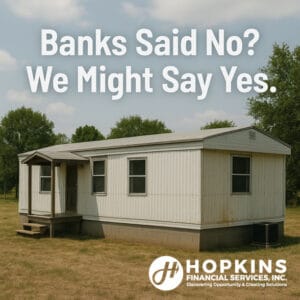
Mobile and manufactured homes have long been some of America’s most affordable housing options, with the cost of mobile homes tending to come out lower than the cost of most site-built homes. This cost-friendliness makes them attractive to first-time buyers, downsizers, and anyone looking to stretch their housing dollars without sacrificing comfort or quality.
When it comes to financing mobile homes, the process isn’t always straightforward, especially if it involves land that does not yet belong to you. While some lenders offer loans for mobile homes, many borrowers quickly discover that this isn’t the same as getting a traditional mortgage. Requirements can also vary widely, and approval standards can shift dramatically depending on land ownership, the home’s foundation, and how the home is titled.
This guide breaks down everything you need to know about financing a mobile home on land, various loan types, how lenders evaluate eligibility, and how private lenders like Hopkins Financial help borrowers who don’t qualify for conventional programs.
What are mobile, manufactured, and modular homes?
Before diving into financing options, it’s important to understand the terminology used by lenders, government agencies, and the housing industry.
Mobile homes
Technically, the term “mobile home” applies to any factory-built housing constructed before June 15, 1976. These homes were built before the Housing and Urban Development (HUD) safety standards for manufactured housing were implemented. Many lenders restrict financing on mobile homes that fall under this technical category, particularly those not on a permanent foundation.
Manufactured homes
A manufactured home is one that is built after 1976 according to federal HUD Code standards. These homes may be placed on leased lots, be it within a mobile home park or on other privately owned land. They may or may not qualify as real property, depending on the foundation and title status.
Modular homes
A modular home is built off-site in sections but is assembled on the land and meets the same building codes as site-built homes. Because of this, modular homes typically qualify for traditional mortgage financing.
Factors that affect financing for mobile or manufactured homes
Several important factors determine how a mobile or manufactured home can be financed. Being aware of these elements can help buyers navigate loan options and choose the most suitable financing.
Key factor #1: Whether the home is on land you own
The biggest difference when financing a mobile home on land versus purchasing in a manufactured home community or mobile home park is land ownership. Lenders have very different treatments to these situations:
- More favorable loan terms or programs are typically offered to borrowers who own the land where the mobile or manufactured home is to be situated.
- Financing choices are typically limited and resale tends to become difficult when the home sits on leased land inside a residential park.
Borrowers who purchase land separately or plan on buying land to place their home on have additional financing considerations, including zoning regulations, utility hookups, and permanent foundation requirements.
Key factor #2: Whether the home is attached to a permanent foundation
To qualify for most mortgage loan programs, a manufactured home must be affixed to a HUD-compliant permanent foundation. A permanent location allows the home to be titled as real property, which may open the door for:
- Conventional financing
- FHA loan programs
- VA loan programs
- USDA loans for eligible rural locations
If the home is not on a permanent foundation, most lenders consider it personal property and will require a chattel loan instead.
Additional factors that affect financing
Keep these factors in mind when seeking financing, as they may affect approvals, interest rate, and/or maximum allowed amounts to be financed:
- Zoning and land use regulations: Before financing or placing a manufactured home, confirm that your land allows manufactured housing. Some cities or homeowners associations restrict them.
- Utility hookups: Septic, water, and power hookups can significantly affect the project’s total cost and financing needs.
- Permanent foundation requirements: If your goal is to convert the manufactured home to real property for long-term financing, foundation upgrades may be necessary.
- Condition of the home: Older homes, especially pre-1976 units, often require private financing only.
- Your overall financial health: Even with private lenders, factors such as income, reserves, and prior property experience influence loan structure.
What lenders require for manufactured home financing
When applying for manufactured home loans, lenders evaluate several eligibility criteria, including:
1. Credit score
Most lenders require you to meet an established minimum credit score, often ranging between 600 and 640 for manufactured home mortgages. For chattel loans, some lenders accept lower scores but charge higher rates. Private lenders like Hopkins Financial place more emphasis on equity and collateral value rather than strict credit thresholds.
2. Down payment requirements
The minimum down payment varies by program:
- FHA loan: As low as 3.5% (if the property qualifies)
- Conventional financing: Often 5%–20%
- VA loan: Zero down for qualified borrowers
- Chattel loans: 5%–20%
- Private loans (like Hopkins): Typically a larger down payment of 25%–35% or more
Private lenders require larger down payments because loans are based on equity and real estate security, not federal guidelines.
3. Financial documents
Expect to provide proofs of financial capability, such as bank statements, tax returns, investment account statements, proofs of income, and any additional requested information. Even so, most private lenders are often far more flexible than banks or credit unions in evaluating your financial situation.
4. Appraisal requirements
Borrowers must prepare to cover certain expenses prior to loan approval, such as appraisal fees, property appraisal reports, and possible engineering certifications. Appraisals for manufactured housing vary based on land status, foundation conditions, and comparable sales.
Why conventional lenders often deny manufactured home financing
Despite the growing popularity of manufactured housing as a more accessible route to homeownership, many banks simply do not finance manufactured homes, especially older units, those without permanent foundations, or homes in certain communities.
Reasons for denial include:
- Home not attached to a permanent foundation
- Title not converted to real property
- Location in a mobile home park
- Age of the home
- Inability to meet strict income limits or credit score requirements
Many borrowers discover too late that the home they plan to buy is not eligible for traditional home financing.
Where private lenders like Hopkins Financial come in
Hopkins Financial is not a conventional lender; we specialize in private real estate–secured loans for borrowers who cannot qualify through banks, credit unions, or federal loan programs.. Here’s what makes Hopkins different:
- Equity-based approvals: We focus on property value, equity, and deal strength, not rigid guidelines or a required minimum credit score.
- Higher down payment expectations: Because we provide flexible financing when traditional lenders will not, borrowers typically contribute 25%–35% down payment or land equity.
- Fast closings: Unlike banks requiring weeks or months of underwriting, Hopkins can fund quickly, which is especially useful when buying land or financing a manufactured property on a deadline.
- Flexible underwriting: Self-employed? Buying a home on acreage? Purchasing a unique manufactured home? Hopkins reviews each scenario individually, not through automated denials.
Solutions for borrowers with no access to traditional lending
If you were told “no” by a bank, FHA lender, or credit union, Hopkins may still help you finance your manufactured home or the land beneath it.
Financing mobile home on land: Your options broken down
Here’s a detailed look at your choices depending on your property type and long-term goals.
Option 1: FHA loans for manufactured homes (when eligible)
An FHA loan can be an excellent path if the home is built after 1976, meets HUD Code, is on a permanent foundation, and is titled as real property.
Pros
- Lower minimum down payment
- Potentially more favorable loan terms
Cons
- Strict installation and foundation requirements
- Extensive documentation
- Not available for homes in parks
Option 2: VA loans (for eligible veterans)
A VA loan may finance a manufactured home on land for qualified borrowers.
Pros
- Zero down payment
- No private mortgage insurance
Cons
- Strict foundation and property standards
- Service eligibility required
- Not available for all manufactured home situations
Option 3: USDA loans for rural properties
USDA loans may finance manufactured homes in eligible rural zones.
Pros
- Zero down
- Good for first-time homebuyers
Cons
- Income limits
- Property must be a primary residence
- Must meet strict manufactured housing requirements
Option 4: Conventional financing through Fannie Mae & Freddie Mac
These agencies offer limited but improving programs for manufactured home financing if the home meets newer construction standards and is titled as real property.
Pros
- Competitive rates
- Long loan terms
Cons
- Not available for older homes
- Avoided by many lenders due to complexity
Option 5: Chattel loans
Chattel loans offer another path when the home cannot qualify as real property.
Pros
- Faster approvals
- Works for homes in parks
Cons
- Higher interest rates
- Shorter loan terms
- Considered personal property loans
Option 6: Private loans through Hopkins Financial
If you’ve been denied for any of the above reasons, or if the property doesn’t meet federal program requirements, Hopkins Financial can help bridge the gap.
We can assist you by:
- Financing a mobile home on newly purchased land
- Buying land and manufactured housing together
- Purchasing homes banks won’t touch
- Financing improvements or bringing foundations to permanent standards
- Helping investors purchase manufactured rentals
Hopkins loans are based on real estate collateral, equity, and closing speed, offering flexibility that’s simply unavailable through government-backed programs.
Your financing path depends on the property and your lender
Financing mobile homes and manufactured homes on land takes more planning than most buyers expect. Unlike purchasing a traditional home, financing options vary widely based on land ownership, foundation type, home age, zoning rules, title status, and lender flexibility.
Banks and conventional lenders often say no — not because you can’t afford the home, but because the property doesn’t fit their guidelines. That’s why Hopkins Financial exists: to provide equity-based, real estate-secured loans for borrowers who need flexible underwriting, fast closings, and financing solutions traditional institutions can’t offer.
Whether you’re financing a manufactured home, buying land for your next project, or need a lender that understands the realities of private mobile home lending, Hopkins Financial is here to help. Contact Hopkins Financial today.